
Out of the city. Into the work.
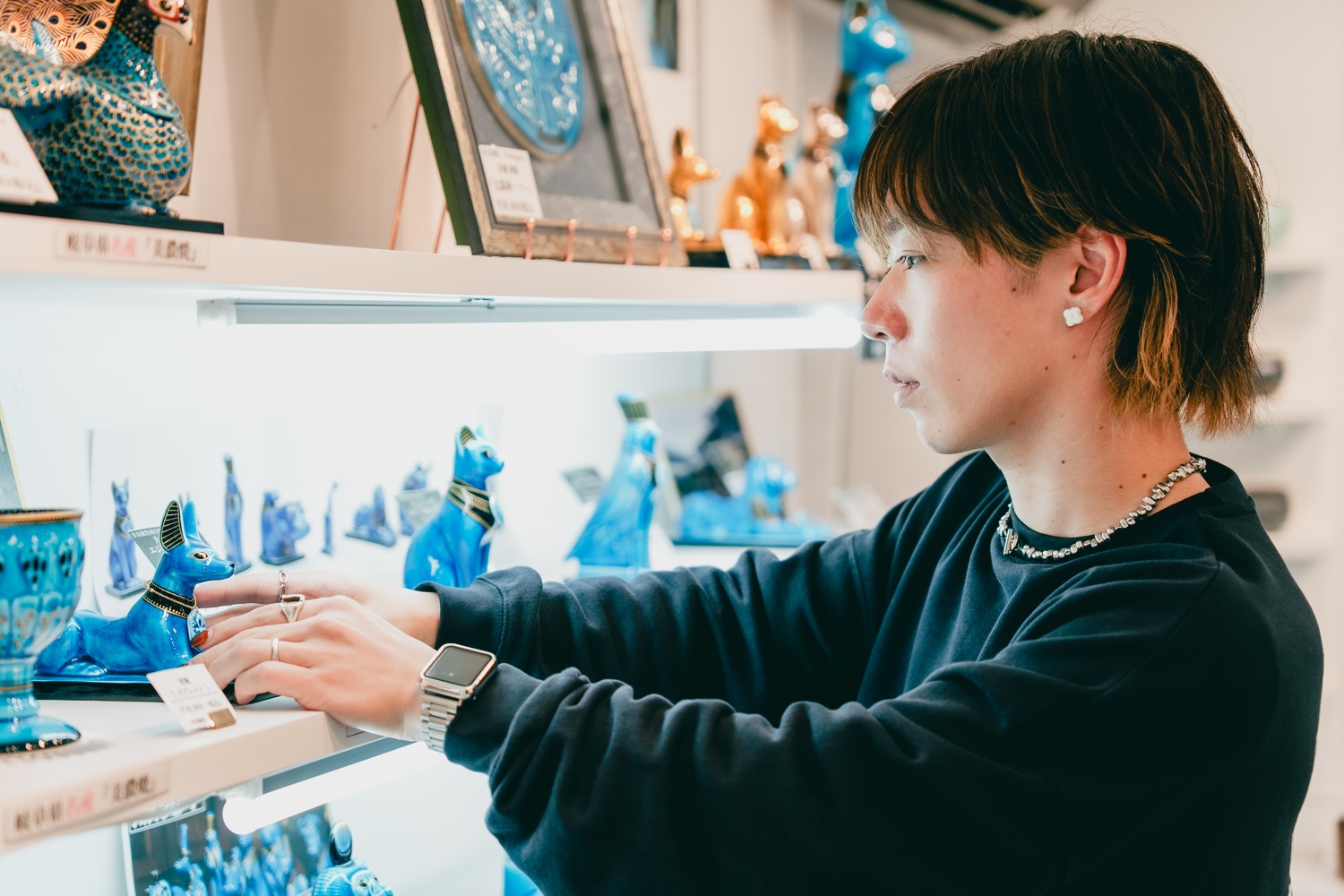
R_degree sits on the main street of Gero Onsen — a hot spring town in the mountains of Gifu Prefecture. Despite the tourist setting, you won't find souvenirs here. What we carry is contemporary Mino-yaki from ten artists we believe define the form today. To our knowledge, no other gallery in Japan curates this tightly.
We didn't build R_degree to sell ceramics. We built it as a place to meet the people behind the work — their thinking, their kilns, their lives.
Pottery was always close.
My grandparents made pottery in Gero. I grew up with the rhythm of clay around me — though as a child, I never thought of it as anything special. It was only later, as an adult, that I came to understand what I had grown up inside. Gifu produces more ceramics than any other prefecture in Japan, and is home to many Living National Treasures of the craft. Quietly, it is the country's ceramic heart.
R_degree began as a way to meet what I had been close to, all along — properly, this time.
Free of a single form.
What drew me in was its freedom. Most Japanese ceramic traditions are immediately recognizable — a glaze, a shape, a marker that says where it came from. Mino-yaki has none of that. Shino, Oribe, Kiseto, Seto-guro — a single name covers wildly different work, made by individual artists chasing their own visions.
The absence of a fixed style is, to me, exactly the point. It's what makes Mino unlike any other ceramic tradition in Japan.
Not just 'something old.'
Japanese craft is in a difficult moment. Fewer successors. Less recognition among younger generations. What should be a culture the world admires is, instead, slowly fading from view — too easily reduced to "something old," kept at a respectful distance.
This needs to change. That's the work I've taken on.
A new generation, telling it differently.
Our staff is young. We pick what looks good to us — by the standards of our own generation — and explain it in our own words. We don't translate tradition by repeating the old script. We translate it into the rhythm of now.
When tradition gets told this way, it reaches people who never thought they were interested in ceramics. That, to us, is how Mino-yaki gets a future.
Not a maker. A teller.
"Do you make your own pieces?" — visitors often ask. I don't. I made the choice early to be a teller, not a maker. To spend my time understanding the work of the artists I trust, and bringing that understanding to the people who walk into the gallery.
What I do is carry the room's response back to the studio — what people notice, what they reach for, what they don't — and sometimes help shape what comes next. Always with the same intent: to make Mino-yaki a little better tomorrow than it was today.
Ten artists. Nothing else.
Most ceramic shops want to be comprehensive. We don't. We carry roughly ten artists at a time — and only ten. Because with ten, we can know each piece. We can tell you who made it, where, why, with what — and what they're trying to do next.
We're not in the business of moving objects. We're in the business of carrying intent. The curation itself is what we have to offer.
One-of-a-kinds. Held aside.
We work directly with each maker, which means certain pieces — work that doesn't travel through the usual channels — only ever appear here. Some never reach the shelves. They live in the back room, until the right person walks in.
If you tell us what you're drawn to, we'll show you what we have.
Art that wants to be used.
Most art lives behind glass. Ours doesn't. The pieces we carry were made to be held — to pour from, to drink from, to eat off of. Like a favorite shirt, a favorite cup quietly raises the floor of a day.
You don't need to be a collector to live with handmade ceramics. You just need a morning coffee, or a meal with someone you like.
Ichigo-ichie. Take it home.
Everything we carry is made by hand. Glaze pools differently on every cup. Weight shifts gram by gram. The rim catches light in its own way. No two pieces are ever alike.
Choosing one — in person, with weight in your hand — is its own quiet ritual. In Japanese, we call this kind of encounter ichigo-ichie: a meeting that comes once, and won't return. If something speaks to you, take it with you.
Mino-yaki, into the present.
R_degree is not just a gallery. It's a translation project. We choose Mino-yaki through the eyes of our generation, tell it in our own voice, and bring it closer to the people for whom it has always felt distant. The goal isn't to preserve tradition under glass. It's to keep it alive, useful, contemporary.
Doing this from Gero — a hot spring town visited by people from all over Japan, and increasingly from abroad — matters to me. To send Mino-yaki out into the world from the same town my grandparents fired clay in, decades ago, is more than coincidence.
I believe the future of Mino-yaki is built one of these encounters at a time. We're here to make as many of them as we can.